

Our Research
Cellular resilience mechanisms and molecular modulation
Our research addresses how cells preserve function during development and ageing, and why inherited defects in cellular quality control produce different disease trajectories. Rare monogenic disorders provide defined models in which molecular alterations can be related to clinical features, cellular dysfunction and response to intervention. We combine patient phenotyping and genetic analysis with experimental investigation of autophagy, organelle homeostasis and intracellular signalling.
Autophagy and intracellular transport
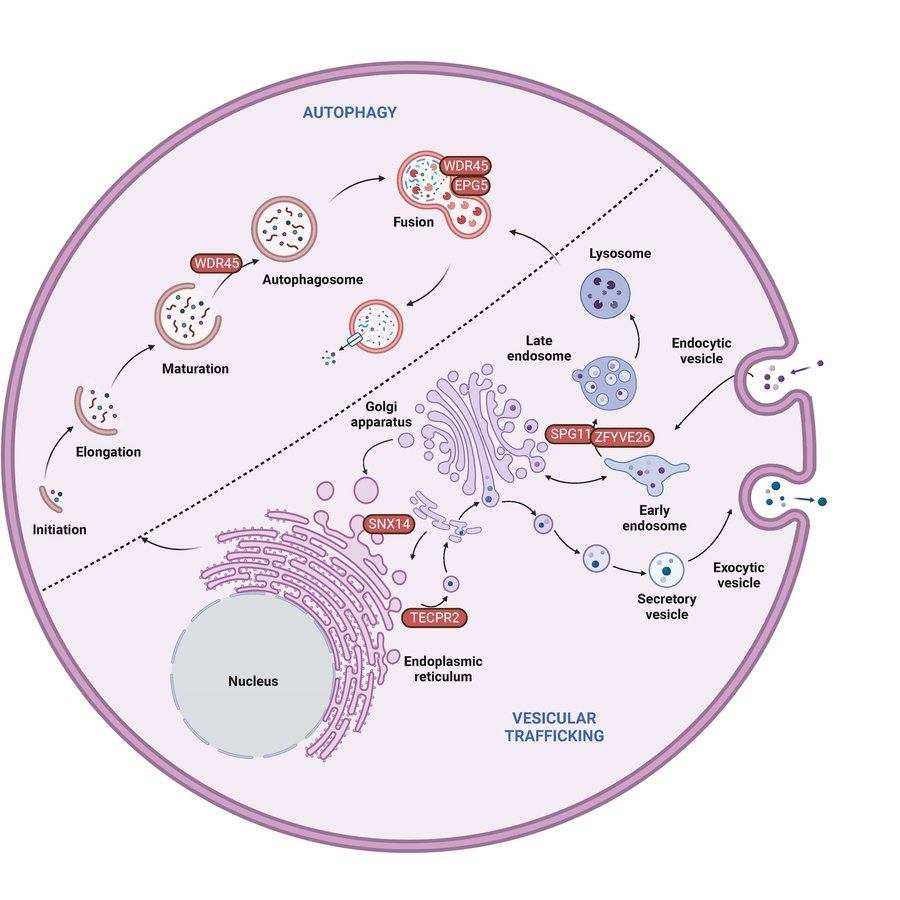
Autophagy removes and recycles damaged proteins and organelles through lysosomal degradation. We investigate how defects in this process compromise neuronal maintenance and immune function. EPG5-related disorders, including Vici syndrome, are a principal focus because they connect severe developmental disease with later neurodegenerative phenotypes. We examine how impaired autophagosome–lysosome fusion affects mitochondrial quality control and neuronal vulnerability.
Our work extends to related autophagy and trafficking disorders involving WDR45, SNX14, LYST, RAB3GAP1, RUBCN, the AP3 complex and DYNC1H1. Across these conditions, we relate genotype and disease course to the cellular steps that fail, with the aim of identifying shared mechanisms and disease-specific therapeutic targets.
Genetic neurodevelopmental disorders
We delineate rare neurological disorders through detailed clinical phenotyping, genomic analysis and functional studies. Longitudinal clinical observations help distinguish developmental impairment from progressive loss of function and identify multisystem features that inform diagnosis and care. Experimental models then allow us to test how the implicated genes regulate cellular function.
A particular focus is PUF60-related disease, in which altered RNA splicing is associated with neurodevelopmental and multisystem abnormalities. We investigate links between RNA processing, cellular metabolism and neuronal function. This work is connected to an Orphanet-registered specialty clinic and collaborative studies through ERN ITHACA. Our broader research network includes partners at University College London, Boston Children’s Hospital and the University of California San Diego.
Clinical resource: PUF60-related disorders in GeneReviews
Neuroimmunology and cellular stress
Autophagy and mitochondrial homeostasis influence both neuronal survival and immune signalling. We investigate how defective organelle clearance promotes inflammatory responses and how these responses contribute to neurological disease. Our EPG5 work identifies mitochondrial calcium dysregulation, mitochondrial DNA release and cGAS–STING activation as experimentally tractable components of this connection.
We also study disorders at the interface of neurology and immunology, including LYST-associated Chediak–Higashi syndrome and LIFR-associated Stüve–Wiedemann syndrome. Clinical research addresses acquired inflammatory CNS disease and postinfectious conditions, with an interest in immune dysregulation, autonomic dysfunction and mitochondrial impairment. University Hospital Cologne participates as a study centre in the BMG-funded PEDNET-LC and COVYOUTHdata projects.
Molecular and RNA therapeutics
We develop and evaluate therapeutic approaches directed at the molecular mechanisms of rare neurological disorders. These include splice-modifying antisense oligonucleotides and small molecules that influence cellular clearance, mitochondrial function or metabolic signalling. We assess whether interventions correct the molecular defect and improve relevant cellular phenotypes, and investigate how treatment timing affects the response.
This experimental programme is closely connected to clinical expertise in molecular therapies at the Department of Pediatrics. Work on new indications remains at the preclinical stage, while established therapies are delivered through the appropriate specialist clinical services.
Experimental approach
We use patient-derived fibroblasts and induced pluripotent stem cell-derived neurons, complemented by genetic studies in Caenorhabditis elegans and collaborative model systems. Autophagic flux measurements, live-cell imaging, mitochondrial bioenergetics and calcium assays, molecular profiling and analyses of inflammatory signalling connect the genetic defect to functional outcomes. Clinical observations guide the choice of models and readouts.
Clinical research and collaboration
Our work is embedded in paediatric neurology and the neurogenetic, neuromuscular, metabolic and neuroimmunology services at University Hospital Cologne. Links to the Center for Rare Diseases and the Center for Gene and Cell Therapy support collaboration across clinical and experimental disciplines. We welcome enquiries about collaborative disease characterisation and functional studies.