

Recent publication on LIFR-related neuroimmunological disorders
A new study led by our group, published in Frontiers in Immunology, describes a wider clinical spectrum of LIFR-related disease, including neurological features and susceptibility to severe inflammation.
Biallelic variants in LIFR cause Stüve Wiedemann syndrome, conventionally associated with skeletal abnormalities and high mortality in infancy. The study describes 22 previously unreported individuals and examines their findings alongside published cases. It highlights the needs of individuals surviving beyond infancy, including neurodevelopmental disorders, allergies, and episodes of excessive inflammation, especially with lethal SARS-CoV2 infections.
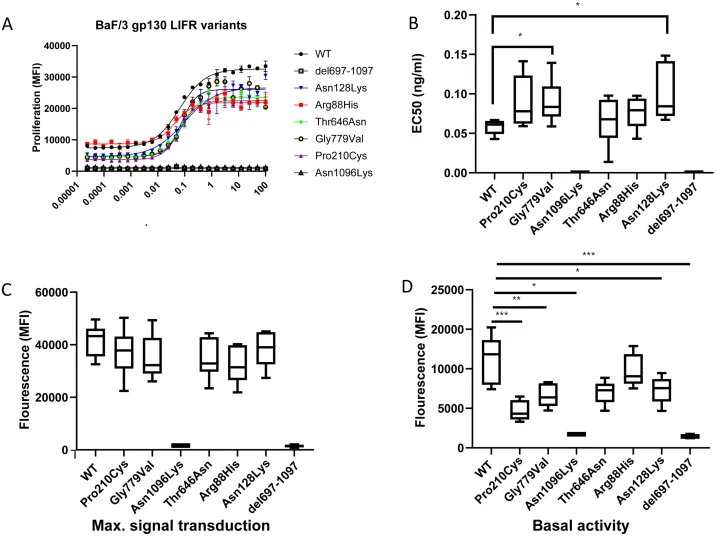
Cellular experiments showed that N-terminal LIFR variants preserve partial receptor activity, while deletorious C-terminal variants may cause more severe disruption. Analyses of patient cells from bronchoalveolar lavage fluid also identified changes in pathways involved in endosomal recycling of LIF-receptor.
Together, these findings help inform clinical assessment and longer term follow up. We are grateful to the individuals and families who participated, and to our collaborators for making this work possible.
Publication: Schmidt M, Rafii P, et al. Hypomorphic biallelic LIFR variants define a multisystem disorder with survival beyond infancy and hyperinflammatory vulnerability. Frontiers in Immunology. 2026;17:1927542.