

EPG5-related autophagy defects linked to epileptogenesis
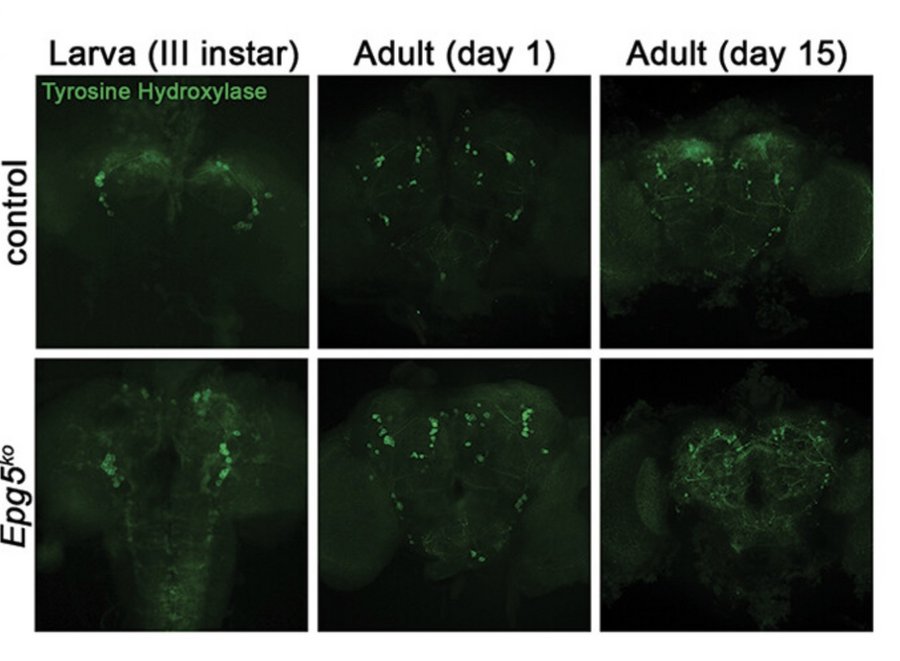
In a study published in the journal Autophagy, an international team investigated seizure-like activity in Drosophila models deficient in Epg5 and related the experimental findings to individuals with Vici syndrome. The work addresses how impaired autophagy may alter neuronal proteostasis and network excitability, thereby contributing to epileptogenesis—the development of a persistent tendency to generate seizures.
Epg5 deficiency in Drosophila impaired autophagic clearance and caused proteotoxic stress, with accumulation of damaged or misfolded proteins. Such disturbances can compromise neuronal function and increase the susceptibility of neural circuits to abnormal, synchronised activity. The researchers also examined age-dependent changes with increased seizures and loss of dopaminergic neurons, which are particularly relevant to EPG5-related disease when neurological manifestations evolve over time.
The study combines mechanistic experiments in a model organism with clinical observations from people with Vici syndrome. This translational design links defects in intracellular clearance to clinically relevant outcomes, including seizures and progressive neurological dysfunction. The findings provide a basis for further studies of how EPG5 deficiency affects neuronal networks and whether restoring autophagic flux can reduce seizure susceptibility.
Reference:
Deneubourg C, Salimi Dafsari H, Lowe S, Martinez-Cotrina A, Mazaud D, Park SH, Vergani V, Almacellas Barbanoj A, Maroofian R, Averdunk L, Ghayoor-Karimiani E, Jayawant S, Mignot C, Keren B, Peters R, Kamath A, Mattas L, Verma S, Silwal A, Distelmaier F, Houlden H, Lignani G, Antebi A, Jepson J, Jungbluth H, Fanto M. Epg5 links proteotoxic stress due to defective autophagic clearance and epileptogenesis in Drosophila and Vici syndrome patients. Autophagy. 2025 Feb;21(2):447-459. doi: 10.1080/15548627.2024.2405956.